
An Inheritance (part X)
The Story of Isocrates

Ch. 10
With some difficulty, Isocrates made it through another sleepless night; if anything, it was a Pyrrhic victory. He stood between Scylla and Charibdis – on the one side, you had the sleep of the damned, on the other, deprivation. The maddening ringing in his ears was becoming unbearable, and now he had a headache to deal with. Indeed, he was tormented, and there was no possible relief in sight.
From here, it would only be downhill.
Now that the sun was up, he felt safe enough to return to the andron, although he remained hypervigilant. At present, he was gazing at the hearth, and the golden tendrils aflicker – he might as well have been staring into his own future. This grew too unsettling, so he went to find something to keep him occupied; idleness is torture, in-and-of itself. He still had all the firewood he could use, and then some, so there was no need, or even space for any more.
He decided that outside chores would be better, as the spider was still lurking; he could not shake the feeling that it was watching him. How glorious it would have been to squash his elusive antagonist; he needed an outlet for his rage – and anguish. After fetching a broom, he went to sweep out the dusty mill, but when he got there, he found the place was already spotless. Usually, this is a good thing, but he was rather disappointed. With a sigh, he went to find something else to do.
While in the area, he checked the silo for any signs of fungus, or mold, but all was in order. It was a thorough inspection though, more so than necessary, as the plan was simply to kill time. After the protracted assessment, the sun was still in the Orient, meaning the plan was failing miserably. A dilapidated barrows lay cross the yard, past the potter’s field. He knew he could find work there, but it would be a waste; the building had not seen use in ages. He tried to think of another task, that was worthwhile.
Since water is a constant necessity, he decided to visit the well, and draw a few buckets. As he was searching about for an empty hydria, the sound of his canine alert-system caught his attention. The barking was coming from the front yard, so he headed that direction, glad for the interruption from ennui. He came round the corner, to find Philetos approaching, and the vociferous Stripe, acting as herald and escort.
“Is everything all right?” Isocrates asked, worried, on account of his sister’s absence – with the recent talk of wolves.
“All is well enough.” Philetos replied tersely.
Isocrates wiped a bit of perspiration from his brow.
“The mistress sent me to collect the rest of her belongings.” The man went on to explain.
Isocrates nodded, and led him inside. While they were in the process of entering, Stripe hurried in too, as if the company were there to see him. Isocrates waited in the vestibule, while Philetos headed off; Stripe went to follow, but was called back. When Philetos returned, he had a saddle-bag over his shoulder, and two large sacks, one in each hand.
“Is that everything?” Isocrates asked, moving to open the door, and hold it ajar.
“I certainly hope so.” Philetos replied, as he went past.
Isocrates waived the pretentious servant off dismissively, and returned to his prior itinerary, going out and making for the well. Stripe headed after Philetos, and this time there was no intervening. The water was drawn, and lugged inside, then it was on to the next random task.
You need not be subjected to particulars, just know that it was tedious, as if time were moving in slow-motion. But albeit seemingly at a snail’s pace, Helios eventually completed His route from east to west. As such, Isocrates wound up indoors, with nothing to do, except light the torches, and prepare for battle.
After wandering the shadowy halls, like an apparition, he ended up back in his brother’s quarters. Stripe had accompanied him on the listless haunt, but as soon as they reached the bedroom, he flopped on the floor and went to sleep. Isocrates was left to wrestle his inner demons, all of which were protean, and they were Legion. He had resumed his spot leaning on the windowsill, and now his elbows were hurting, nearly as much as his ankles.
He looked over at the bed, and once again, he thought of surrendering – is it worth fighting, when there is no hope of winning? He asked himself this, then a vivid image of the burning hall flashed cross his mind’s eye. Thus, he was reminded of why he had to be strong; it was an ordeal, but he refused to cave. He watched as, outside, the world was slowly taking shape, starting off in black-and-white, then transitioning to polychrome. It was not long before Stripe was up, and after a good stretch, he was back in action.
Isocrates yawned.
* * *
The day was setting up to be like the one prior, with an attempt to stay busy, or at least to stay awake. But it was not getting any easier, with his lack of options, and his failing grasp of reality. Once out of ideas – and the strength – to do anything but sit, the very act of concentrating became a chore.
Mind you that his ears were still ringing, and his head was still pounding, and his chair felt a little too comfortable. His eyelids were like unto portcullises; having been engaged, they were trying to slide into place. He knew that if were to stay put, he would soon succumb; the thread that he was hanging on by was badly frayed.
He desperately needed to get away, and leave his troubles behind, even if only but momentarily. He forced himself to his feet, and vertigo struck; he had to sit back down, to regain his equilibrium. After he got his head on straight, he gave it another go; this time he managed to keep himself erect. Although he was still wobbly, he was ambulatory – and quite determined.
We must give him that.
He left the house, and went to track down Stripe, finding the hound well beyond the outer wall, where it had no business being. He gave the dog a piece of his mind, per the usual – by now, we know he was wasting his breath. Stripe put on a show of contrition worthy of a standing ovation, before being led back through the gates, and secured within.
With that out the way, Isocrates embarked on his extempore outing, making for the ridge, and descending. It was only a shade past midday, and clouds like massive heaps of shorn wool, served to tamp down the heat. But the going was rougher than usual, the gradient seeming somewhat steeper than he last recalled.
From the foothills, he found his way to a wooded patch, made up mostly of planes, the bark peeling away like dried up skin. He cut a path through the psoriatic boughs, and once again, the din in his head had competition, as there were plenty of cicadas still trying to seal the deal. Eventually, the sound of a distant chattering joined the cacophony, becoming louder as he continued onward. Shortly thereafter, he reached his intended destination, an ovoid glade, where a multitude was celebrating.
The local Harvest Festival was well underway, having kicked off at first light; it would continue till nightfall. Scores of folk were in attendance, all packed tightly in the clearing, amounting to the whole of the community. As they were celebrating the fruitage of the earth, there was a grand feast, reflecting the various crops produced. There was also a great deal of drinking taking place – the fruit of the vine is always a hit at get-togethers.
Isocrates hesitated a moment, as he spied from the treeline; he did not expect a warm reception. But warmth is a relative term, and, at present, any social interaction was preferable to isolation. Taking a deep breath, he stepped from his wooded covert, and went off to join the gathering – and was immediately rebuked. First to spot him was a group of elderly women; one of them shrieked, as if she had seen a ghost. This caught the attention of several others nearby, all of whom reacted by stopping fast, and twisting their faces.
“You’ve some gall, coming here.” Were the words of a man called Alcinous, an aging, but still imposing cattleherd.
“I have as much right to be here, as anyone else.” Isocrates replied defiantly, before continuing on, hoping to find a more sympathetic lot.
Oh, but alas, it was as if he carried with him a stench.
Of course, Alcinous was not the only one with something to say; Isocrates received a litany of scathing remarks. He was labeled a brigand, and a blackguard, and all sorts of other things – the people were quite creative. He took it in stride, until someone shouted, “You should be ashamed; your father would be.”
That one struck a nerve.
He stopped and scanned the surrounding throng, for who might have said it, and faced a sea of possibilities, there were so many leering suspects. Isocrates scowled, and resigned to simply press on. It bears mentioning that half the crowd consisted of ebullient adolescents, too busy at play to take note of him – he wished that he could be so frivolous. But those of the mature generations continued reacting with disgust, or contempt, or a mixture of both. He ignored all the stares, and the biting words.
He passed the spot where kindling had been arranged, in conical fashion, for the bonfire, which would occur later on. A few meters from this, lay a freshly dug pit, which would also get put to use during the upcoming rite. A bit farther on, a group of revelers were busy treading grapes in a shin-deep vat. Isocrates saw his sister amongst them, stomping enthusiastically, and decided not to rob her of the moment’s joy. She had made it abundantly clear, that she did not want his miasma – he would give her the space that she asked for.
As such, he slipped on past, before she caught sight of him; by virtue of geometry, he ended up mid-clearing. Here, the food and drink had been set out on several tables; Isocrates ignored it – his appetite was still on hiatus. With no such qualms, flies were swarming the vicinity, greedily partaking in the buffet.
“Isocrates?!” A woman’s voice called after him – one he would know anywhere – he turned and saw his sister approaching. She was accompanied by a group of friends, who held back a couple steps, as she came the rest of the way over to meet him. “You made it, after all.” She began; Isocrates barely heard her though.
His attention had been captured by her retinue.
As they had all been frolicking in the vat, their peplums were hiked up just above their knees, to avoid the purple stains. This was far more provocative than one might assume – in those days, you rarely had the chance to see more than ankles.
“Isocrates!” Carnaea exclaimed, as if he were hard of hearing, and she were not standing right in front of him.
“There’s no need to shout.”
“You didn’t seem to be listening.”
“I hear you.” He replied, continuing to ogle.
“Talitha said she saw you go by; I told her she must have been mistaken, yet she was adamant.”
“It’s me, in the flesh.”
“That flesh is coming to look more and more corrupted – are you still making use of the sleeping-aid I provided?”
“It’s still in my possession.”
“That’s not what I asked you.”
“I’ll make sure it doesn’t go to waste.”
She rolled her eyes.
“Tell your friends they don’t have to be so shy.”
“That’s not why they kept their distance – I told you, you look terribly unwell.”
“Do assure them that I’m in excellent health.”
“I can’t, when I share their trepidation.”
Isocrates scowled, “It’s probably best you run along, then – before someone suspects that you’ve contracted my nonexistent malady.”
“Who cares what they think; I want to help you.”
“You can’t.” He said flatly, before continuing on his way.
He heard her call after him again, but he did not look back, as he did not want her to see he was weeping. As he went along, he was hailed with another string of invectives; he pretended not to hear it, but he did. He came upon the spot where an altar was located, just a raised stone slab – which is all you really need. There, the remains of a goat, sacrificed to Dionysus, were still smoldering on the blackened platform.
Tending to the smoking altar – and serving as the master of ceremonies – was Nikephoros, the local priest. The wizened cleric was a recluse, who only came down from his small temple on the mount, on special occasions. For some reason, Isocrates did not want to be seen by the prelate, so he kept a wide berth. The surrounding crowd was less dense than elsewhere, and there was an air of solemnity that made Isocrates feel uneasy. Why it would have this, or any effect, he had no idea.
He certainly was not the religious type.
Now up ahead, some old men were sharing words and libations; one of them happened to glance in his direction, “Look who we have here.” Uttered the senex, breaking away from his cadre, and slowly limping over.
Isocrates steeled himself for yet another verbal assault.
“Why have you no drink in your hand?” The man asked, which caught Isocrates by surprise.
As such, he did not respond.
“Here, take mine – I can get another.” The old man went on to add, holding forth his cup.
“I’m thankful for the offer, but I must refuse.”
“It’s a celebration lad, in honor of our heavenly benefactors.”
“I’m aware, and still prefer to abstain.” Responded Isocrates.
The old man’s expression became sympathetic, “It does make sense that you wouldn’t be in the mood for merriment, so soon after the loss of your father – my condolences, by the way.”
“Your kind words are appreciated.” Isocrates replied, and in light of his recent treatment, he was being sincere.
“He was taken from us much too soon.” The old man remarked.
“That, he was.” Lamented Isocrates.
“Good thing he left behind a capable heir.”
“Either you’re mistaken, or you mean someone else.”
“Nonsense; you’ve already proven that you’re forward thinking.”
“And how might that be?” Isocrates asked, cocking an eyebrow, curious as to what sort of virtue the man thought he saw.
“You’ve set out a plan to keep us safe! – we should put some food aside, lest we’d rather be food for Hypatos’ birds.”
“Were that there were others who agreed; everyone else has come to hate me, like I were a vile son of Echidna.”
For emphasis, Isocrates made a gesture towards the man’s associates, all of whom were staring daggers at him.
“How people view you matters little; facts and opinions are very often at odds.” Said the wise old man.
Isocrates nodded, but he was hardly consoled, as the old man did not know the whole story.
“What are your plans to deal with the wolves?” The man went on to inquire.
Isocrates shrugged, not having given it any thought – as he kept no livestock, it was not a priority.
“Your failure to respond gives me pause, but I know you’ll handle the matter; protecting is in your blood.” The old man proclaimed, with confidence and admiration.
If not for the circumstances, Isocrates might have laughed.
“We can’t just sit around and have people disappearing.” The man added.
This choice of phrasing caught Isocrates’ attention, “People disappearing?”
“Yay indeed; I would have thought you had heard – Linos’ youngest son went missing yester…a blood trail was found, leading off into the groves.”
“What a shame; Linos must be crushed.”
“He’s enraged.” Came the response.
“I assume that traps were laid?” Isocrates asked.
“Wolves are clever, lad; they’ll have to be hunted down. And you’ll have to lead the effort.”
“What am I needed for?”
“Because you’re our lord!” The man replied, in exasperation.
Isocrates grew quiet again; he was unconvinced. Since this was the only neighbor who had not treated him like a pariah, he lingered there with him for a while. He even allowed the man to talk him into drinking, though he opted instead for new wine, and passed on the old.
This whole time, he had been trying, in vain, to place a name to the wrinkled face, which he was certain he recognized. But, for the life of him, he could not remember what the man was called, and it always feels wrong to ask. Eventually, the man excused himself to go rejoin his companions, leaving Isocrates on his own again.
He stood upon the edge of the glade opposite his entry, and rather than heading straight back, he cut around the perimeter. He did not want to run into his sister again, or the priest – he was dodging both of them. There came another inundation of booing and hissing, as well as some rude gestures, he blocked it all out. This was working fine, till the chance sight of his former best-friend stopped him in his tracks, and caused his heart to sink.
Poor Delearces looked like a man straight out of triage, wrapped in as many bandages as he was clothes. His mother was with him, and neither of them were rejoicing, instead they simply stood there on the sideline observing. Isocrates headed over towards them, still unnoticed by the pair.
Lamon appeared and stopped him from going farther, “Get thee away!”
“I mean to apologize.” Isocrates tried explaining, but Lamon would not yield.
While this was occurring, Delearces had taken notice and, leaning on his mother, headed in the other direction.
“Wait!” Isocrates shouted, scuffling with the obstinate Lamon, who continued to act as sentry.
In the ensuing struggle, Isocrates pushed a bit harder than he really meant, sending Lamon to the ground. He went to help him up, but the man refused, and stood by his own means.
“Had I known you were coming, I’d have skipped the event.” Said he, brushing the dirt from his chiton.
“You judge me far too harshly.”
“Says the guilty party.”
“If you’ll only let me explain.”
“There is no need.” Lamon said with finality, before going after his wife and son.
Young Antipas had popped up as well, and still stood there staring like he meant to charge; Lamon shouted, ordering him to follow. He hesitated a little longer, before running off. Isocrates shuddered to think the lad was so full of hatred.
One might think that, with such behavior, Lamon was the fiercest detractor there, but that distinction still fell to Alcinous. Isocrates reencountered the outspoken cattleherd, who all but leapt at the chance, to unload his vitriol.
“Can’t you see that you’re not welcome – why are you still here?” He began.
Isocrates offered no rebuttal; he was wondering the same.
“There’s nothing worse than one whose existence is based on taking advantage of his fellow man.” Alcinous remarked.
“We benefit off of one another; such is the meaning of community.” Responded Isocrates.
“As if you were part of the community; you dwell in a palace high above us, while we do all the work, down here.”
“Were we to trade places, you would see my lot in life is nothing to covet.”
“That’s easy for you to say.” Replied Alcinous. “But would you say the same after a day in the field, watering Ge with your sweat?” The man asked.
Isocrates was unsure how to respond to that.
“A man can sweat all he wants,” Carnaea interjected, emerging from the crowd to come to her brother’s defense, “but are we not provided for by the grace of the Goddess?”
“That we are, my lady, but –“
“Careful, lest you blaspheme.” She cut him off with a not-so-subtle warning.
Committing sacrilege was a capital offense.
Nodding respectfully – to Carnaea – Alcinous proceeded in skulking out of sight.
“I could have taken care of that on my own.” Isocrates complained.
“I know that you could.” She replied.
He could not tell if she was being sarcastic, or genuine. Daylight was fading, and he had well had enough, but Carnaea convinced him to stay for closing ceremonies. Everyone gathered round as Nikephoros set a torch to the bonfire; the tender ignited, and the glade lit up.
A piglet was loosed, and people scrambled to catch it, with all the grown-ups pretending, so that the honor went to a child. Isocrates remembered trying – year after year – to catch one himself, and coming up empty-handed every time. The piglet was captured by a lass, garnering much adulation from her elders, and jealousy from her peers. After taking a victory lap, she carried her squealing captive to the pit, and tossed it in.
People then came forward to refill the hole with dirt, with the piglet protesting loudly, till it was covered up. As the pit was being filled, people also made a grand show of wailing and moaning – though not for the pig. The mourning was over Eubouleus the swineherd, who was caught in the right place, at the wrong time.
A number of torches had been prepared beforehand, which were divvied, still unlit; they ran out before getting round to Isocrates. Those who had been given one, lit them in the bonfire; the glade became even brighter, as if they skipped past the night. Nikephoros went on to lead the crowd in a group song, an ancient hymn titled Heliodoros – Isocrates sang along, but there was no feeling in his words.
After they finished singing, the celebration officially ended, but people still hung around, many grabbing food to-go. Carnaea promised she would come to visit on the morrow, and cook fish-soup, like their mother used to do. After insisting that Isocrates take her torch with him, she left with her friends, and he finally headed home.
Thanks to the torch, his path was illuminated, but this was unnecessary; he could have made it back, blindfolded. All told, it was a particularly dark night, with just a sliver of moon, and not a star to be seen. Anyway, he did have some light, for whatever that is worth, and some aching knees, after climbing the hillside. Stripe was waiting for him when he opened the door, not to greet him, but to quickly brush past – nature called.
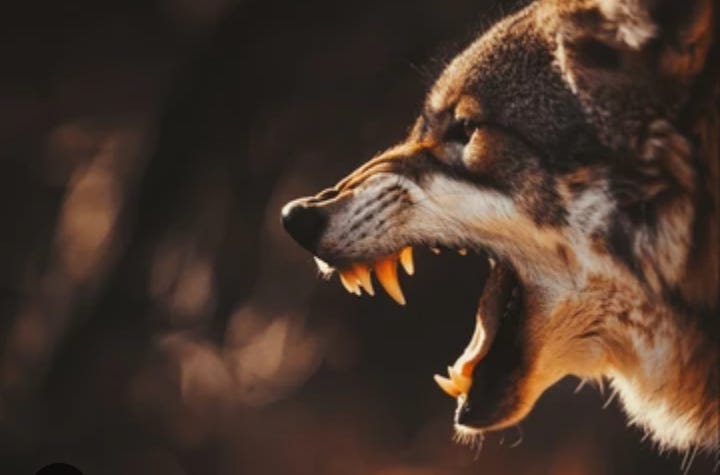
Isocrates could go for the same; the cup of wine that he drank earlier had run through him now. He went out to his favorite spot, and proceeded to relieve himself. Midstream, Stripe came slinking towards him, his body low to the ground, growling menacingly, and with teeth bared. Isocrates heard a second growl, behind him, and quickly spun round, to find a snarling wolf, a meter from where he stood. The beast’s attention was not on him; it had its eyes on the hound, which continued to advance. Isocrates still had the torch in one hand, and himself in the other; he let go of the latter, and backed away.
Stripe stepped out in front, to come between him and the threat, and now the two of them were facing off, nearly nose-to-nose. The wolf backed up a bit, but still seemed ready to strike, while Stripe had taken up a protective stance before his master. The wolf was somewhat smaller than Stripe, but not by much; it was still quite large for a wolf, though. It was just inside the sphere of light the torch emitted; beyond it, Isocrates saw the glint of another set of eyes.
His heart was already racing, and now it beat faster still; he went and took hold of Stripe by the neck-scruff. Dragging the dog with him, he backed up again – the house was that way. The visible wolf had started forward, and soon was joined by the other, that had been lying in wait. The wolves were stalking warily, but the distance was closing; Isocrates glanced back, to see how far they had left to go.
As he was looking over his shoulder, he caught sight of yet another wolf, on their flank, hurrying to cut them off. He thought to look the other direction, and sure enough, there were two more there, as well, moving into place. As if by some unknown signal, they attacked at once; Isocrates swung the torch in sweeping arcs. Stripe wrenched free.
The efforts with the torch were keeping the wolves away – from Isocrates; Stripe had taken the battle to them. But, due to the numbers, he started off at a disadvantage; each time he pinned one down, two more were on top of him. Without even thinking of his own safety, Isocrates went to Stripe’s defense, using the torch as a club. This worked to get a wolf off of Stripe’s back, but now his own circle of protection had been broken.
A wolf came and lunged at him, trying to sink its teeth in his leg, but luckily, it got a mouthful of chiton. He struggled to get the garment loose; it seemed the wolf tried to pull him off his feet – which would have been very bad. With a fierce tug, he got the fabric to rip, but then the wolf struck again, and this time its maw found purchase, just below his knee.
He yelled out in pain.
The sound seemed to invigorate Stripe; somehow, he got out from the pile he was under, bolting to Isocrates’ aid. The wolf that was clamped onto his leg, was tackled and taken down, taking a chunk of his leg with it. He yelled out again, but there was no time to worry over injuries – he still had to make sure he survived. As before, the torch was used as a bludgeoning instrument; he bashed a wolf once, then a second time, then the torch broke in half.
The fiery head landed in the midst of the melee, doing more to break it up than his clubbing attempts. He seized on the moment to grab hold of Stripe again, and yank him backwards, the last few steps to the door. He still had to open it, and the wolves were right there, seemingly intent on having a midnight snack. And now his only weapon was the handle from his torch, which he threw at the nearest wolf, to buy a little more time.
It was just enough to crack the door open, and to get himself, and Stripe, inside, and to slam it closed. Right afterwards, the door sounded with multiple heavy thuds, showing how close of a call it had just been. Next, there were scraping noises, and some angry growls, both from outside, and inside as well – Stripe was going off. He was baying hysterically, and leaking blood everywhere, and yet he was ready to fight again. Isocrates dropped down to his knees, ignoring the searing pain in his leg, from the recent vicious bite.
Wrapping his arms round Stripe’s big, bloody neck, he squeezed with all his might, thanking the dog for having just saved his life.
(to be continued…)
Become a paid Subscriber, to access the entire vault, or Buy Me A Coffee, to support my work…
Glad to have you back